Presentación en la PUCP:Red de Investigación de la Democracia Andina, "Más allá de la democracia electoral: hacia democracias ciudadanas en Los Andes"

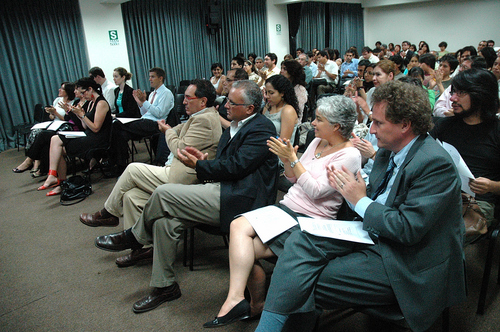
The Andean Democracy Research Network findings presented at the Catholic University of Peru, Feb 23, 2010.

PRESENTACIÓN DEL INFORME : “Más allá de la democracia electoral: hacia democracias ciudadanas en Los Andes”. Maxwell Cameron, Universidad de British Columbia Los comentarios estuvieron a cargo de Eduardo Dargent, Sinesio López y Martín Tanaka.

Una investigación coordinada por la Red de Investigación de la Democracia Andina y que ha tenido como objetivo central proveer una evaluación continua y sistemática del estado de la democracia en la región Andina utilizando un esquema metodológico común que permite comparaciones tanto de casos como en el tiempo. Centro Cultural de la Universidad Católica, Lima, Perú, Martes 23 de febrero 7 p.m.

Fotos de la presentación:
http://fotos.pucp.edu.pe/albums/compartido/1600

Presentación Maxwell Cameron en la PUCP (en powerpoint)

PUCLima


PUCLima2

A Coup is a Coup is a Coup

Published in The Mark

October 14, 2009.

By Maxwell A. Cameron

Justifications for the removal of the Honduran president ignore one crucial fact: there’s no such thing as a constitutional coup.

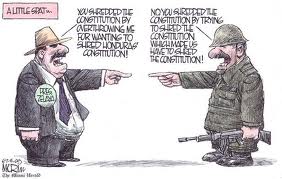
A lesson of the forcible removal of President Zelaya from Honduras is that coups can still occur in Latin America. Make no mistake: what happened was a coup. It doesn’t matter that the military acted on a court order – courts were complicit with the coup in Chile in 1973. It doesn’t matter that the architects and beneficiaries were civilians, as was the case in Ecuador in 2000, or that the coup itself was a relatively genteel affair by historical standards. It doesn’t matter that the president has occasionally behaved idiotically.

What does matter is that nothing the president did justifies his removal by force without due process. It matters that Zelaya was sent into exile rather than arrested and brought before a judge, and that the de facto regime has not proven in a court of law that the president broke the law. (What is more, he did not break the law: at no time did Zelaya propose to change the re-election rule, nor could he have done so before leaving office.) And it matters that the actions of Micheletti and his cronies violated the letter and the spirit of the law and were also inconsistent with basic principles inherent in all constitutions.

And please, let us not fall into the trap of calling this a constitutional coup. What is a constitutional coup anyway? The concept, which has no place in law or scholarship, is at best a trope to designate a Machiavellian ruse whereby a constitution is changed by what appear to be constitutional means when, in fact, it is emasculated to perpetuate incumbents in power. A coup is, by definition, a change in the constitutional order by non-constitutional means. And that is exactly what happened in Honduras.

You might say, “But the constitution has not been changed, it has been upheld.” Wrong! The Honduran constitution has been interrupted and altered. The current de facto regime holds power by virtue of non-electoral and non-constitutional means. And a new rule has been added to Honduran politics: don’t even think about constitutional change or you’ll be exiled or arrested.

The fact that the Micheletti gang can find articles of the constitution that support what they have done is irrelevant. Constitutional framers are no smarter than the rest of us, and they often write dumb things into constitutions. The Honduras constitution is full of absurd articles that shouldn’t be there, and is missing essential articles that should (most crucially, an impeachment clause). But it also contains principles inherent in all constitutions – principles that have been violated even as the coup-mongers point to formalities in the constitution that they feel justify their actions.

This brings us to the challenge we now face. The Western Hemisphere must become a coup-free zone. Now you might say, don’t we already have an Inter-American Democratic Charter that is supposed to make the coup a thing of the past? Well, in fact, one of the biggest problems with the Charter is that it does not define or specify what counts as an “unconstitutional interruption or alteration of the constitutional democratic order.” Yes, the Charter describes democracy, and does so rather comprehensively. But it does not define the obverse: the features of a non-democratic regime.

What is a coup? I suggest a method for discerning coups, based on the theory that “if it waddles like a duck, flaps like a duck, and quacks like a duck, it probably is a duck.” Here are some of the quacks, flaps, and waddles that count as coups:
1 Arbitrary or illegal termination of the tenure in office of any democratically elected official by any other elected officials.
2 Arbitrary or illegal appointment, removal, or interference in the appointment or deliberations of members of the judiciary or electoral bodies.
3 Interference by non-elected officials, such as military officers, in the jurisdiction of elected officials.
4 Use of public office to silence, harass, or disrupt the normal and legal activities of members of the political opposition, the press, or civil society.
5 Failure to hold elections that meet generally accepted international standards of freedom and fairness.
6 Violation of the integrity of central institutions, including constitutional checks and balances providing for the separation of powers.
7 Failure to hold periodic elections or to respect electoral outcomes.
8 Systematic violation of basic freedoms, including freedom of expression, freedom of association, or respect for minority rights.

The coup in Honduras fulfills conditions 1, 3, 4, 6, and 8; and 5 is imminent. Let’s call a duck a duck.

What about Zelaya? Did he not also act in defiance of both the judiciary and election authorities and, therefore, violate conditions 2 and 6? I’m not persuaded. Zelaya did not purge or stack the Supreme Court or electoral authorities; he did not close Congress; he did not suspend the constitution. Moreover, to remove Zelaya because he insisted on a non-binding consultation is like hitting a child for hitting another child. Imagine what would happen if we were to generalize this practice. Evo Morales could dismiss every prefect who held a referendum on autonomy in Bolivia.

Honduras’ de facto leaders have opened a Pandora’s box inside of which quivers every impulse to repress, censor, abuse power, and violate human rights. There is a danger that the events in Honduras may be repeated elsewhere, either in the immediate neighbourhood or in the Andes. But if they spark a move to clarify the meaning of a coup, and this is incorporated into the Democratic Charter, we could very well find that the threat to democracy is also an opportunity to improve the way we support it.

– This is a revised version of a talk presented at the Canadian Council for International Co-operation, Ottawa, October 7, 2009.

Update on the Honduran Crisis


By Rebecca Alegria Monnerat
October 1, 2009

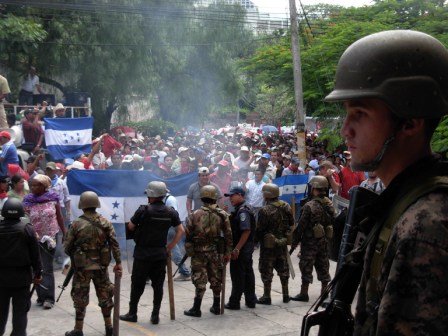
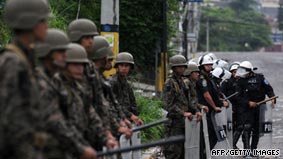
On the morning of Tuesday, September 22, 2009, masked Honduran security forces used tear gas and rubber bullets to disperse supporters of deposed President Manuel Zelaya that surrounded the Brazilian Embassy where Zelaya sought refuge upon returning to Honduras. Demonstrators outside the Embassy were defying a curfew imposed by the de facto government from 4:00 pm on Monday to 6:00 pm Tuesday. Up to 300 people were detained and many were reportedly being held at a stadium in Tegucigalpa. There were reports of people injured and 10 dead, while the government has so far only confirmed three deaths.

In an effort to avoid escalating violence, at an emergency Organization of American States (OAS), the Chair of the Permanent Council of the OAS called for “respect for Human Rights of all Honduran citizens, and for full guarantees for the security of the Honduran leader and the Diplomatic Representation of Brazil in Honduras.”

De facto leader Roberto Micheletti initially denied Zelaya’s presence in the country and subsequently denounced the claims as “media terrorism”. Once Zelaya’s return was confirmed, a surprised Micheletti demanded that Brazil hand over Zelaya so that he could stand trial, and warned that Brazil would be held responsible for any violence. Celso Amorim, Brazil’s Foreign Minister argued that threats made against Zelaya and the Brazilian Embassy would violate international law.

Three months after being ousted, Zelaya surreptitiously returned to Honduras on Monday, September 21. His return is viewed as irresponsible by some who see a risk of increasing violence in an already volatile political climate. Others welcomed the move as a bold step to regain momentum after talks to resolve the crisis had stalled.

While in office, President Zelaya had planned to hold a non-binding public consultation on 28 June to ask voters whether they supported changing the constitution.  This “consultation” would have involved adding a question to November’s presidential election ballots and would have opened the door to a process of rewriting the constitution. Zelaya’s critics claim this was his attempt to remove the one-term limit for presidents, as stated in the constitution, a charge Zelaya denies, pointing out it would be impossible for a constituent assembly to rewrite the constitution before the November elections, and that in January 2010, Honduras would have a new president.

Under Title VII of the Honduran constitution, the constitution may only be amended by the National Congress after a two-thirds vote in two consecutive annual sessions; however, certain provisions may not be amended, including the length of the term of office and prohibition on reelection.

Zelaya’s attempt to push forward the vote on June 28 was seen as unconstitutional by the Supreme Court. After he was deposed, the National Congress voted retroactively to remove Zelaya over “repeated violations of the constitution and law”.  Zelaya was taken at dawn from his house on the day of the vote and, in his own words, told to surrender or be shot.

The President was then put on a flight to Costa Rica, while Roberto Micheletti, the Speaker of Congress was sworn in as interim president. Zelaya has since spent most of his time in exile in neighboring Nicaragua a nation that, under the leadership of Daniel Ortega, has been supportive of Zelaya.

Tension in Honduras has been growing since Zelaya, of the Liberal Party, won the presidential elections in 2005 with a majority of 75,000 votes. A former businessman and seemingly sitting to the center-right, Zelaya began moving the country steadily to the left once in office, winning support from other left-wing leaders in Central and South America. In particular, as Zelaya became increasingly friendly with Venezuela’s Hugo Chavez and the nations that form part of the ALBA (the Bolivarian Alternative for the Americas), his relations with local elites and the media were strained.  Fears that Zelaya was bringing Honduras into the orbit of some of the more radical leftist leaders of the region appear to have been a prime motivation for the coup.

The issue of re-election was also a flash-point for conflict, particularly since many leaders in the region have used the strategy of constitutional reform to eliminate or relax term limits. Various countries of the region have overhauled their constitutions, perceiving those in effect to be, by regional standards, too liberal and exclusionary of marginalized social sectors. Argentina, Venezuela, Ecuador, Bolivia have, for example, all voted to amend their constitutions in recent years.

These moves are not limited to left-wing governments. Colombia’s 1991 constitution initially prohibited the immediate re-election of the president. In 2004, changes were made to the constitution to allow for re-election, giving Alvaro Uribe a second term in office. Additionally, while it still requires negotiation by the House of Representatives, and subsequent review by the Constitutional Court, the Colombian Senate in May 2009 passed a bill that would allow a referendum to decide whether the president could be elected for a third term.

While some of these constitutional reform processes ran more smoothly than others,  Zelaya’s support base was considerably smaller than the large grassroots support base seen in countries like Bolivia and Venezuela, which provides some insight into why a seemingly innocuous move by Zelaya was so controversial in Honduras.

However, since Zelaya’s removal, many on the Honduran left have rallied to support the elected president, including labour unions, students, and indigenous groups. Human rights groups in Honduras have made claims that the security forces have used excessive use of force in repelling mobilizations by these sectors.

With the failure of the San Jose Accord, the proposal to end the crisis put forward by Costa Rica’s Preseident Oscar Arias, a new round of negotiations seemed increasingly difficult. Zelaya’s return to Honduras could be read as a somewhat desperate attempt to restart these negotiations.

The clock is ticking.  For many countries in the hemisphere, recognizing the elections scheduled for November could legitimize the de facto regime and set a poor precedent for both Honduras and the broader region. OAS Secretary General José Miguel Insulza has stressed that he does not wish to return to an era in which caretaker coups were commonplace.

In a September 14, 2009 video-conference broadcast to various Canadian universities, Insulza spoke of his frustrations regarding the limitations on what the international community can do. Using one of the few tools for negotiation the OAS has at its disposal, Honduras’ membership has been temporarily suspended.  Another option would be to place an embargo on the country, which few would prefer due to both the large percentage of Honduran exports that travels to the rest of the region and out of consideration for the Honduran population that would likely be hit hardest by the effects of an embargo. The World Bank has suspended aid and the US government has revoked US visas to government officials, including that of Micheletti.

Insuzla argued that the Inter-American Democratic Charter needs to be reformed, pointing out that it does not clearly define an “alteration” or “interruption of democratic order”. He lamented the few provisions the OAS has for anticipating problems, and little or no tools at its disposal for reacting to crises. He urged the need for widening the spectre of authority: currently, the OAS Secretary General can only take complaints from heads of state, but not from Congress members.

When asked about the issues that are most problematic for reaching an agreement in the San Jose Accord, Insulza pointed to two main points causing the deadlock. The first is the current interim government’s refusal to reinstate Zelaya to serve his last three months as president. The second problem stems from the interim government’s refusal to grant Zelaya political amnesty because of their assumption that this would by default involve pardoning Zelaya’s criminal acts.

Insulza reiterated that the events in Honduras are unacceptable and stressed the need to respect both the principle of non-intervention and the defence of democracy at each step of the resolution process. Insulza is standing by to travel to Honduras as soon as the Tegucigalpa airport reopens.

It is difficult to prognosticate about what will happen next. Various news sources have speculated that Micheletti’s army might attempt to take over the Brazilian embassy. Brazil and the US are urging the United Nations to hold an emergency meeting over the standoff at the Embassy. Brazilian President Luiz Inacio “Lula” da Silva has demanded that Zelaya be reinstated and refuses to turn him over to the de facto government; meanwhile, Micheletti’s government refuses to reinstate Zelaya and urges Brazil to hand him over or grant him refugee status in Brazil. Zelaya seems willing to stand trial, but is determined to be reinstated.

In the meantime, Micheletti’s interim government has given the Brazilian Embassy a 10-day ultimatum to release Zelaya or grant him asylum in Brazil, and has also instated an emergency decree that suspend civil-liberties for a 45 day period, although Micheletti says they may be restored before then. Unauthorized public meetings have been banned and two media outlets, Radio Globo and Cholusat Sur TV, have been shut down. The US government has condemned the emergency decree, saying “The freedoms inherent in the suspended rights are inalienable and cannot be limited or restricted without seriously damaging the democratic aspirations of the Honduran people.”

The previous OAS consensus that Zelaya should be immediately reinstated seems to be breaking down. On Monday, September 28th, the US, Canada, Costa Rica, Bahamas and Peru were considering dropping Zelaya’s reinstatement as a precondition for having credible elections. Adolfo Facusse, a businessman who backs Micheletti suggested allowing Zelaya to have a symbolic return to power but do so under house arrest and face corruption charges.

If Zelaya is not returned to power and elections are held as planned, chances are that the international community may not see the elections as legitimate. UN Secretary General Ban Ki-moon does not believe the current situation is setting Honduras on the path towards “credible elections” set for November, and the UN has suspended electoral assistance.  The most significant effect of Zelaya’s return to Honduras may be that it has complicated the de facto regime’s strategy of hanging tough until the November election in the hope that the next government can mend fences with the international community.

The Aftermath of Bagua: Lessons for Democracy in Peru

REUTERS, Felix Paricahua

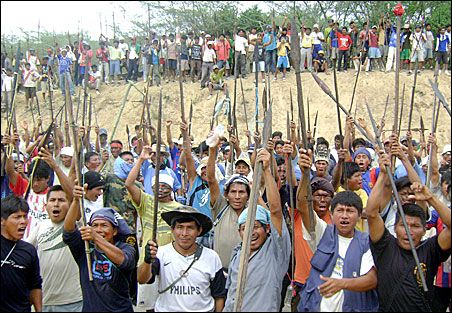
On June 5, 2009, in the Bagua Province of the Peruvian Amazon, dozens of people were killed and more than 200 were injured when national police attacked indigenous protesters that had mobilized against a series of legislative decrees. When word of the attack reached nearby communities, groups of indigenous and mestizo people retaliated against police installations, and the death toll surged. The official count of those killed is 23 police officers, 5 indigenous people, and 5 local mestizos. Indigenous groups contest these figures and claim that around 40 Awajún and Wampi indigenous peoples died, alleging that bodies were dumped in nearby rivers, although no evidence has been produced to confirm these reports.

The decree laws – issued by President Alan García in 2008 under special powers granted by the legislature (Law #29157) to facilitate the implementation of a free trade agreement with the U.S. – would open broad areas of the Amazon to mineral, oil, logging and agricultural exploitation. For example, one decree withdrew the requirement (not always enforced) that resource extraction firms acquire informed consent from local communities prior to entering their lands. García’s decrees were issued without consulting indigenous communities that stood to have their lives and territory affected, and with minimal transparency. The following accounting of what took place on June 5 highlights several deficiencies in Peruvian democracy: (a) citizens’ most basic rights are periodically violated in the enactment of the state’s coercive powers, (b) there remains a high level of political and social exclusion of marginalized groups, especially rural and indigenous peoples, and (c) presidents have a tendency to concentrate power – through rule by decree and issuance of states of exception.

The series of confrontations occurred when the head of special operations (DIROES), General Luis Muguruza, led security forces in an assault to dislodge a blockade established by thousands of indigenous protesters on a stretch of the Fernando Belaúnde Terry Highway known as the “Devil’s Curve.” The blockade had been part of a series of non-violent protests by indigenous groups over the course of eight weeks, which had involved the closure of road travel, river navigation and oil facilities. Although those opposed to what they called the “Laws of the Jungle” had pursued negotiations over the decrees for more than a year, the García Administration declined to consult with local communities prior to their passage. [1]  Instead of dialogue, García opted for confrontation, issuing a state of emergency on May 9, 2009, which suspended various constitutional protections, including the freedom of assembly and movement.

Those amassed at Devil’s Curve had hoped that a truce negotiated with the police the night before would allay a confrontation. However, at approximately 6:00 am, a verbal exchange between the police and protesters intensified, and without warning the police began shooting teargas and live ammunition indiscriminately into the blockade. The protesters responded by hurling rocks and spears, and police helicopters appeared overhead, also firing bullets into the crowd. Numerous deaths and injuries occurred on both sides.

News traveled rapidly, spurring two subsequent incidents. One took place in the nearby town of Bagua, where the situation turned riotous. A crowd of protesters engulfed the police station until police snipers opened fire from the rooftop, killing several of those below, including one indigenous leader, Felipe Sabio César of the Wawas community. The other site of violence – for some Peruvians, a more shocking one – occurred at a nearby pumping station 6, part of the North Peruvian Oil Pipeline, where 10 police officers were killed.

Weeks earlier, thirty-eight poorly equipped police had been sent to guard the pumping station. They entered into a non-aggression agreement with the community, and according to one officer developed a sort of camaraderie, with food shared and games of table football. The police were not informed in advance that the highway assault was to occur. That news arrived first to the indigenous people present via radio, who, outraged by reports of their comrades’ deaths, surrounded the police. Outnumbered and still unaware of what had taken place, the police surrendered their weapons, and were tied up and taken “hostage,” according to Garcia’s Prime Minister Yehude Simon, who described the situation in a press conference that evening. During the subsequent attempted rescue, ten of the police were killed in what some reports describe as “executions”. [2]

The decision to attack the highway blockaders occurred with no apparent concern for the police at pumping station 6, nor a plan for their safe withdrawal, despite intelligence reports that informed the administration of the situation there. Common sense suggests that retaliation against state actors and facilities was a possible response to the assault, and that the police at the pumping station were likely targets. The omission has spurred allegations of criminal negligence, incompetence, and disregard of intelligence on the part of Interior Minister Mercedes Cabanillas and national police generals that planned the strike on the highway.

As noted above, the death toll remains contested. An investigation by Peru’s Defensor del Pueblo (Ombudsman) found that police constituted the majority of those killed (23 of the 33 identified bodies),  [3] and these numbers have been accepted as the government’s official accounting of lives lost. However, several witnesses have charged that the police disposed of bodies in the Marañon River, and many indigenous people that had joined the protests have not yet been accounted for or returned to their communities.

A statement issued by the Organizing Committee for the Indigenous Peoples of Alto Amazonas Province declared: “It is appalling that political powers have acted in such a cruel and inhuman manner against Amazonian peoples, failing to recognize the fundamental rights and protections guaranteed to us by the Constitution.”  [4] Peru’s National Coordinator of Human Rights similarly laid blame at the feet of the state, alleging “negligence and the bad political decisions of the Government and the Congress have contributed in a fundamental way.”  [5]

With clear allusions to Sendero Luminoso (Shining Path), President García defended the police action as necessary to confront “subversive anti-democratic aggression,” while condemning the indigenous response as “savage and barbaric.” In an earlier racially-tinged declaration, García had declared, “Enough is enough. These peoples are not monarchy, they are not first-class citizens. Who are 400,000 natives to tell 28 million Peruvians that you have no right to come here? This is a grave error, and whoever thinks this way wants to lead us to irrationality and a retrograde primitivism” [emphasis added]. The pronouncements imply the view that indigenous people are less worthy of full enjoyment of their constitutional rights. Moreover, the president asserted that the land in question does not belong to indigenous communities, but to the state, and that the decreed laws are necessary to develop the country for all Peruvians. In addition to inflaming opposition, García’s discourse risks reproducing discriminatory stereotypes of indigenous peoples, deepening social cleavages, and reinforcing existing ethnic inequalities.

In the immediate aftermath of Bagua, a Peruvian judge issued an arrest warrant for Alberto Pizango, president of the Inter-ethnic Association for the Development of the Peruvian Amazon (AIDESEP), on charges of inciting the violence. Peru’s national indigenous organization, AIDESEP represents 1,350 indigenous communities that together comprise 350,000 people. Pizango, who blamed President García for what he describes as “genocide,” fled to Nicaragua, where he has been granted political asylum.

The fallout from the day of violence has been unfavorable for the government of García, who was forced to admit that “there were a series of errors and exaggerations” in the government’s actions on June 5. Prime Minister Simon asked the Congress to repeal two of the ten laws that spurred the protests – Decrees 1090 and 1064, which would have accelerated development of the agricultural and forestry sectors in Peru’s Amazon. The Congress overwhelmingly rescinded the two laws on June 18, while García’s other decrees remain in force. Simon subsequently resigned from his post. In early August 2009, public prosecutor Luz Rojas brought charges of homicide against two police generals, including General Muguruza, and 15 officers; however, it remains uncertain whether the case will move forward. [6]

Beyond the sheer loss of life, what transpired at Devil’s Curve throws a spotlight on several shortcomings of Peruvian democracy. On display in the bloodshed of June 5 was police use of excessive force, concentration of power in the executive branch, lack of transparency and consultation, and the state’s disregard for human life, of not just those that challenge it, but its own agents of coercion. A more fundamental problem that underpins the unfortunate chain of events is the political and social exclusion suffered by indigenous peoples in Peru. Although Bagua represents an extreme case of Peru’s failure to ensure constitutionally protected rights, democracy will remain shallow unless the country develops policies and practices that ensure this segment of the population achieves “first-class citizen” status.

Sources:
1. Coordinadora Nacional de Derechos Humanos (2009), “Sobre el Paro de las Comunidades Nativas y la Urgencia de Dialogar,” Internet, http://www.dhperu.org/prensa.php?op=prensa&id=35.
2. Instituto de Defensa Legal (2009), “El Horror,” Internet, http://www.seguridadidl.org.pe/destacados/2009/11-06/el-horror.htm. See also IPS (2009): http://ipsnews.net/news.asp?idnews=47248.
3. Defensor del Pueblo (2009), “Actualizaciones Humanitarias Realizadas por la Defensoría del Pueblo con Ocasión de los Hechos Ocurridos el 5 de Junio del 2009, en las Provincias de Utcubamba y Bagua, Región Amazonas, en el Contexto del Paro Amonónico.” Informe de Adjuntía # 006-2009-DP/ADHPD.
4. Amazon Watch and Inter-ethnic Association for the Development of the Peruvian Amazon (2009), “Eyewitness Reports Accuse Peruvian Police of Disposing the Bodies of Dead Indigenous Protesters,” Internet, http://www.amazonwatch.org/newsroom/view_news.php?id=1843.
5. Coordinadora Nacional de Derechos Humanos (2009), “CNDDHH Desmiente Falsa Información y Aclara que No Ha Denunciado al Estado por Genocidio,” Internet, http://www.dhperu.org/prensa.php?op=prensa&id=114.
6. See El Comercio: http://www.elcomercio.pe/noticia/326373/denuncian-generales-policia-muerte-nativos-bagua.

Statement by the Friends of the Inter-American Democratic Charter on the Honduran Coup, Sunday, June 28, 2009

June 30, 2009

FOR IMMEDIATE RELEASE

Contact: Deborah Hakes, 404-420-5124

Faced with the occurrence of the coup d’état in the Republic of Honduras, Sunday, June 28,

We, the Friends of the Inter-American Democratic Charter, express our great concern for the rupture of the constitutional order in the Republic of Honduras that took place on June 28, 2009.

We consider unjustifiable and unacceptable that an institutional political crisis would be resolved through an act of force. Use of force to interfere in the mandates of elected political officials has been condemned by the hemisphere since the Santiago Declaration of 1991, reiterated in the Inter-American Democratic Charter in 2001,  and has no place in the 21st century.  Instead, dialogue, constitutional mechanisms, legal procedures, and respect for due process should be used to resolve conflicts between branches of power or to investigate alleged illegal or unconstitutional acts by any political actor.  These procedures were not followed in Honduras; nor was the OAS offer of good offices utilized.

At the same time, we recognize that disputes arose between the branches of government in recent months and days over whether and how to reform the constitution.  We are aware of the defiance of the president in the wake of rulings by the Supreme Court and the Congress, but also emphasize that the president did not attempt to dissolve either of those branches of government.
In virtue of these facts, we express the following:

  1. The Friends of the Democratic Inter-American Charter categorically reject the forceful action that removed President Zelaya from office.
  2. The political crisis should be resolved according to the established constitutional procedures in an atmosphere of respect to all institutions.
  3. The process of institutional reestablishment should begin with the reinstatement of President Zelaya, the commitment of all branches of government to respect the authority of each of the others, and respect for all proceedings established in the Honduran Constitution, particularly those for the amendment of the Constitution itself.
  4. The American states should cooperate with the legitimate Honduran authorities to initiate a dialogue to resolve the political crisis and the inter-branch conflict consensually, applying constitutional mechanisms and the principles of the Inter-American Democratic Charter, in particular the rule of law, respect for the Constitution, human rights and the separation of powers.

Friends of the Democratic Inter-American Charter

Carlos Ayala Corao
Former President
Inter-American Commission on Human Rights
Cecilia Blondet
Former Minister for the Advancement of Women and Human Development
Peru
Fernando Carrillo-Flórez
Former Minister of Justice
Colombia
Joe Clark
Former Prime Minister and Former Minister of Foreign Affairs
Humberto de la Calle
Former Vice President
Colombia
Diego García Sayán
Judge
Inter-American Court of Human Rights
John Graham
President
Canadian Foundation  for the Americas (FOCAL)
Canada
Barbara McDougall
Former Sercretary of State for External Affiars
Canada
Advisor, Aird & Berlis LLP
María Emma Mejía
Foreign Foreign Minister
Colombia
Pedro Nikken
Former President
Inter-American Court of Human Rights
Sonia Picado
Chair of the Board of Directors
Inter-American Institute of Human Rights
Sergio Ramírez
Former Vice-President
Nicaragua
María Isabel Salvador
Former Foreign Minister
Ecuador
Jorge Santistevan de Noriega
Former Human Rights Ombudsman
Peru
Fernando Tuesta Soldevilla
Former Director
National Office of Electoral Procseses
Peru
Robert Pastor
Former Director of Latin American and Caribbean Affairs,
National Security Council
United States
Jennifer McCoy
The Carter Center
Secretariat to the Group of Friends of the Inter-American Democratic Charter

The defence of democracy cannot be selective

Maxwell A. Cameron

From Tuesday’s Globe and Mail Last updated on Tuesday, Jun. 30, 2009 11:16AM EDT

You don’t burst into a palace in a blaze of gunfire, rouse a pyjama-clad president from his bed, stick a gun to his head, force him onto a military plane and spirit him into exile in another country, and then call what you did “constitutional.”

Yet that is exactly what has happened in Honduras since Sunday. It is absolutely clear that the country’s constitutional and democratic order has been “interrupted,” to use the phraseology of the Inter-American Democratic Charter.

So it is a relief that the international community has responded with remarkable unanimity, at least so far. Instead of acting on the basis of whether the ousted leader is a “good man” or a “bad man,” as his predecessor would likely have done, U.S. President Barack Obama has allowed his administration to be guided by the Democratic Charter, a binding document on members of the Organization of American States. His instincts are multilateral.

OAS ambassadors assembled and immediately expressed vigorous condemnation of the coup d’état. They demanded Manuel Zelaya’s return and said no government arising from it will be recognized. Secretary-General Jose Miguel Insulza shuttled around Central America, building support for Honduras’s possible suspension. Leaders throughout the region have echoed his support for Mr. Zelaya. Canada’s Minister of State for the Americas, Peter Kent, condemned the coup, although he stopped short of calling for the President’s return. An OAS meeting scheduled for today will be decisive.

At stake is nothing less than whether Latin America will return to an era of coup-mongering. It is unlikely that Latin America will see a resurgence of the brutally repressive regimes of the past; what we are witnessing is a 21st-century version. In this model, the President has been removed to stop him from following a script written in Venezuela, Bolivia and Ecuador. Indeed, the coup’s entire plotline is redolent of the ouster of Venezuelan President Hugo Chavez in 2002, complete with a bogus letter of resignation.

What the coup leaders want to stop is a referendum to convene a constituent assembly. They fear the assembly would usurp their power, then institute reforms to sweep away traditional parties and politicians. These fears resonate in some quarters of the international community, causing some to privately doubt whether Mr. Zelaya is a worthy cause. Critics consider him a populist demagogue of the same ilk as Mr. Chavez, and believe an attempt to restore him to power plays into the hands of radicalism.

Such views are no basis for decision-making in a crisis like this. The international defence of democracy cannot be selective or based on ideology.

Another ostensibly legitimate but in fact misguided concern is that Mr. Zelaya had already acted unconstitutionally himself. By attempting to proceed with a non-binding consultation, he opened the door to his own removal. After all, how else can you stop a President bent on defying the will of the Honduran Congress and the explicit instructions of the country’s Supreme Court?

It is true that by ignoring Congress and judiciary, Mr. Zelaya acted in contempt of Honduras’s legal and constitutional order. He should have worked harder to find a solution to the dispute. But he did not close the Congress or remove the Supreme Court. He may have acted unconstitutionally, but he did not overthrow the constitutional order. Nothing he did justifies his removal by the military.

The real arbiters will be the Honduran people. No president can change a constitution by plebiscitary means without massive public support. A deep desire for participation has been the key to the political success of Mr. Chavez in Venezuela, Evo Morales in Bolivia and Rafael Correa in Ecuador. It is unclear whether Mr. Zelaya can elicit a similar level of public support – that will be key in coming days.

The international community will need to be creative and pragmatic, but it must be clear on one point of principle: With the removal of an elected President, the democratic order has been interrupted. Normal relations with the rest of the Western Hemisphere should likewise be suspended pending the restoration of Mr. Zelaya’s government.

Maxwell Cameron teaches comparative politics (Latin America) and international political economy at the University of British Columbia.

Constitutional Analysis: Honduras

Prepared by the Carter Center, reproduced with permission.

1. What are the provisions/justifications in the constitution to remove a president? Is there an impeachment procedure?

Currently, there is nothing written into the Honduran Constitution regarding impeachment or removal of the head of state. Under the powers of the Legislative Branch, Article 205 did have a provision that mentioned a process determining whether or not to pursue actions against the president: Article 205 § 15: Declare whether or not there are grounds for the formation of a cause against the President. (Repeal 157 2003). This section was repealed in 2003 and was not replaced by any other provisions. Article 205 § 45 provides for the Congress to create laws regarding anything not provided for in the Constitution.

2. Does the Honduran president have the power to remove chiefs of the Armed Forces?

The President has the power, under Article 245 § 5, to freely name And remove functionaries and employees whose naming to office is not been given to the other branches of government. In addition, Article 280 under the powers of the Armed Forces, the President has the power to name and remove from office the Secretario de Estado en el Despacho de Defensa Nacional and the Jefe del Estado Mayor Conjunto de las Fuerzas Armadas.

3. What are the constitutional provisions to amend or reform the constitution? Does it provide for a Constituent Assembly? Who can call for constitutional reforms (e.g. petitions of signatures, request of president, vote in Congress)?

Article 373 provides for the amendment process through the Congress in an ordinary session by 2/3 vote of all members. Article 5 provides for direct democracy provisions, plebiscite and referendum, that allow for changes to the constitution. To call a referendum or plebiscite, the Congress must have a 2/3 vote on the regulations and procedure prior to it taking place.

4. Is there a prohibition in the constitution on changing the article limiting presidential terms to a single term?

Article 374 prohibits changing the term limit of the President and re-election.

5. Is there any procedure for the Supreme Court to enforce its own rulings if it instructs another branch, such as the executive, to do something?

If the ruling is given under the Sala de lo Constitucional (Article 316), then the Supreme Court has the power to resolve disputes between the branches of government and it is effective immediately. There are no enforcement provisions though and no other mention of powers the Judiciary has over the other branches. Everything is left to ordinary law.

Update: Political Situation in Honduras

The following analysis of the was prepared by Elena Cryst for the Carter Center.  It is reproduced her with permission.

On Sunday, June 28 2009, a military coup took place in Honduras against president Manuel Zelaya. The armed forces took over the presidential residence, defeating the Presidential Guard, and captured the president. They then put President Zelaya on a military plane bound for San Juan, Costa Rica. The congress quickly appointed Congressional President Roberto Micheletti as the Provisional President of Honduras. The Supreme Court announced that it authorized the coup and ordered the army to remove the president.

President Zelaya was elected in 2005 as part of the center-right Liberal Party. The President draws much of his support from Union groups and rural workers. He later aligned himself with the growing Left-wing coalition in Latin America by joining the Chavez-led Bolivarian Alternative for the Americas (Alba) in 2008. Honduras, which has traditionally been closely tied with the United States and is a member of the Dominican Republic-Central American Free Trade Agreement (DR-CAFTA), has thus under Zelaya been moving to ally itself more closely with its more leftist neighboring countries. In a public opinion poll collected in 2008 by Latinobarómetro, the President received a 35 percent approval rating. Confidence in the Government in general was 25 percent, and 26 percent of people indicated that they had a lot or some confidence in the Congress. Recent opinion polls have put approval of President Zelaya as low as 30 percent.

Tensions were rising over the past few weeks and months between the executive on one side, and the armed forces, the congress, and the Supreme Court on the other over Zelaya’s intention announced last year to call for a Constituent Assembly to draft a new constitution. President Zelaya proposed a non-binding public consultation for June 28 to approve the inclusion in the November 2009 national elections a question calling for the creation of a Constituent Assembly to draft a new constitution. It is speculated that Zelaya would like the Constituent Assembly to include presidential reelection among the constitutional reforms. As it stands, Honduras elects presidents for one non-renewable four-year term, and the current constitution prohibits any change to that provision. President Zelaya’s term was set to end after the November 2009 elections.

The Supreme Court ruled that the popular consultation was illegal. Congress reaffirmed the judicial ruling by approving a law last week that prohibits any popular referenda within 180 days, before or after, of the national elections. President Zelaya then asked the head of the Armed Forces, Romeo Vásquez Velásquez, to support the president in the vote scheduled for Sunday, June 28. When Vásquez refused, Zelaya fired him. The Supreme Court immediately ordered that the President reinstate Vásquez. President Zelaya refused.

On Friday, June 26, the Permanent Council of the Organization of the American States (OAS) held an emergency meeting regarding the impending crisis in Honduras. They resolved to support the democratic constitutional government of Honduras. They called all political and social actors in the country to respect the government with the hopes of avoiding a rupture of the constitutional order and peace in the country. They also decided to organize a Special Commission under Secretary General José Miguel Insulza to visit Honduras to help find a democratic solution to the impending situation.

Before the OAS mission arrived, Zelaya was forcibly removed from the presidential palace by the armed forces the morning of Sunday, June 28. The Congress then voted to name Roberto Micheletti, President of the Congress and member of Zelaya’s Liberal Party, as the new president, in a unanimous vote with 124 of 128 members present, saying that Zelaya had acted unconstitutionally by defying the Supreme Court.

After the Coup on Sunday morning, the OAS Permanent Council held an emergency meeting to draft a resolution on the political situation in Honduras. They adopted a resolution strongly condemning the coup d’Etat, declared it a “constitutional alteration” under the Inter-American Democratic Charter, and demanded the “immediate and unconditional return of President José Manuel Zelaya Rosales to his constitutional duties.” The resolution instructed Secretary General to attend the previously scheduled meeting of Central America presidents in Nicaragua on June 29, and stated that no governments would recognize the newly-installed government in Honduras. It also condemned the detention of the Minister of Foreign Affairs, Patricia Rodas, and the Mayor of San Pedro Sula, as well as other ministers and associates, and demanded their immediate release. The OAS General Assembly will hold a special session on June 30, to make appropriate decisions in accordance with the Charter of the OAS, international law, and the provisions of the Inter-American Democratic Charter. They will also forward their resolution to the Secretary General of the United Nations.

In the wake of the events Sunday morning, the countries of Latin America have unanimously condemned the coup and noted that they will not recognize Micheletti as president of Honduras. President Obama announced his deep concern and called on all political and social actors in Honduras to respect democracy. He affirmed that the United States would only recognize Zelaya as president. President Hugo Chavez of Venezuela announced that he would attack Honduras if the military invades the Venezuelan embassy in Tegucigalpa. He has put the Venezuelan armed forces on heightened alert. In the Honduran capital, hundreds of Zelaya supporters have taken to the street, setting up road blockades and burning tires. Micheletti imposed a curfew on the country hours after being sworn in as an attempt to restore order.

In an interview with CNN en Español, acting president Micheletti said that the military was trying to enforce a decision from the Supreme Court, and that President Zelaya didn’t have respect for the democratic process. He invited other countries to come investigate the coup in Honduras, claiming that the new government is a civil government with a congressional and judicial mandate. Meanwhile, in a public address, Zelaya called Micheletti “a pathetic, second-class congressman who got that job because of me, because I gave you space within my political current.”

SOURCES

AFP, 26 June 2009

Agencias/Clave Digital, 28 June 2009

Al Jazeera, 26 June 2009

Associated Press, 26 June 2009

BBC, 29 June 2009

Guardian, 29 June 2009

Hondudiario, 28 June 2009

The Independent, 29 June 2009

El Libertador, 29 June 2009

Nacion, 29 June 2009

The New York Times, 29 June 2009

OAS, 26-29 June 2009

La Republica, 29 June 2009


The Washington Post, 28 June 2009